
What Is a Grid-Connected PV System? A Complete Guide to How It Works, Benefits and Applications
Solar energy is becoming an increasingly popular choice for homeowners and businesses looking to reduce electricity expenses and adopt cleaner energy solutions. Among the different types of solar installations, a grid-connected photovoltaic (PV) system is one of the most widely used options.
But what exactly is a grid-connected PV system, and how does it work?
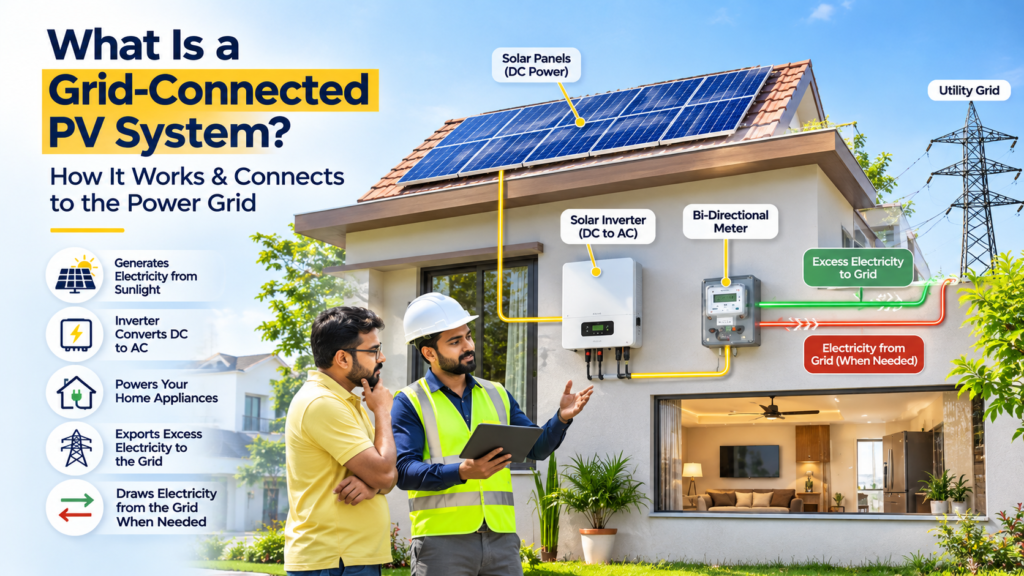
A grid-connected PV system is a solar power installation connected directly to the local electricity distribution network. It generates electricity from sunlight and supplies power to your home or business. When solar production exceeds your consumption, surplus electricity can be exported to the grid, subject to applicable net-metering or other approved arrangements.
This system allows consumers to use solar energy during the day while maintaining access to conventional electricity whenever required.
In this guide, we will explore the working process, major components, advantages, limitations, and applications of grid-connected solar systems.
What Is a Grid-Connected PV System?
A grid-connected photovoltaic system, also known as an on-grid solar system, is designed to generate electricity using solar panels while remaining connected to the utility electricity network.
Solar panels absorb sunlight and generate direct current (DC) electricity. The solar inverter then transforms this power into alternating current (AC), making it suitable for use by household and commercial electrical equipment.
The generated electricity is generally used by connected appliances first. If the solar system produces more electricity than the property requires, the surplus may flow into the utility grid through an approved connection.
If solar power generation does not meet the property’s electricity demand, the remaining power is supplied by the utility grid.
Unlike an off-grid solar installation, a standard grid-connected system does not require batteries to operate. However, it generally cannot provide backup electricity during a grid outage unless it includes specially designed backup equipment and an appropriate system configuration.
How Does a Grid-Connected Solar PV System Work?
Understanding the working process of a grid-connected PV system is relatively simple. It involves converting sunlight into usable electricity and coordinating solar generation with the utility grid.
Here is how the process works:
1. Solar Panels Capture Sunlight
Photovoltaic modules are installed on a rooftop or another suitable location. When sunlight reaches the solar cells, they generate DC electricity through the photovoltaic effect.
2. The Solar Inverter Converts Electricity
Solar panels generate electricity in the form of direct current (DC). Household and commercial electrical appliances generally operate using AC electricity.
A grid-connected solar inverter converts the generated DC power into AC electricity and synchronizes its output with the utility grid.
3. Solar Electricity Powers Your Appliances
The electricity generated by the system supplies the property’s connected electrical loads. This reduces the need to obtain electricity from the utility provider, helping lower overall power costs.
4. Surplus Electricity Can Be Exported
When solar generation is higher than the property’s immediate electricity consumption, excess electricity may be exported to the distribution network, provided the installation has the required approvals and metering arrangement.
5. Grid Electricity Is Used When Needed
During nighttime, cloudy weather, or periods when solar generation is insufficient, the property can draw electricity from the utility grid.
This combination allows consumers to use solar generation without depending entirely on battery storage.
Main Components of a Grid-Connected PV System
A properly designed solar installation includes several components that work together to generate and distribute electricity safely.
1. Solar Photovoltaic Panels
Solar panels are the primary electricity-generating components. These cells, known as photovoltaic cells, absorb sunlight and generate direct current (DC) electricity.
The number and capacity of panels depend on the property’s energy consumption, available installation area, and project requirements.
2. Grid-Connected Solar Inverter
The inverter changes the DC power generated by the solar panels into AC electricity and synchronizes the system’s output with the utility grid.
Modern inverters may include monitoring features that help users track energy generation, system performance, and operational conditions.
3. Net Meter or Bi-Directional Meter
An approved bi-directional meter can record electricity imported from the grid and electricity exported from the solar installation.
The applicable billing treatment depends on the state’s regulations, DISCOM policies, and the approved metering arrangement.
4. Mounting Structure
Mounting structures provide firm support and keep the solar panels securely fixed in place. They are designed according to roof conditions, panel orientation, tilt requirements, and environmental conditions.
A suitable structure helps maintain stability and provides appropriate support for the solar modules.
5. Electrical Protection Equipment
Protection devices help safeguard the installation against electrical faults and other operating risks.
Depending on the system design, these may include:
- DC and AC isolators.
- Surge protection devices.
- Suitable circuit breakers.
- Earthing arrangements.
- Lightning protection where required.
- Appropriate cables and connectors.
6. Solar Monitoring System
Monitoring equipment allows users to observe electricity generation and identify unusual performance changes.
Depending on the inverter and monitoring platform, users may be able to check solar production through a mobile application or online dashboard.
Types of Grid-Connected Solar PV Systems
Grid-connected solar installations can be designed for different property sizes and electricity requirements.
1. Residential Grid-Connected Solar System
These installations are designed for houses, apartments with suitable individual connections, and residential properties.
Homeowners can use solar-generated electricity to operate lights, fans, refrigerators, televisions, and other appliances. System capacity depends on household consumption and available rooftop space.
2. Commercial Grid-Connected Solar System
Commercial solar systems are installed at offices, shops, hotels, educational institutions, hospitals, and other business premises.
Businesses with substantial daytime electricity consumption may benefit from generating a portion of their electricity through rooftop solar.
3. Industrial Grid-Connected Solar System
Industrial installations are designed for factories, manufacturing facilities, warehouses, and other large electricity consumers.
These systems can help businesses offset part of their grid electricity consumption, depending on their operating schedule and available installation area.
Advantages of a Grid-Connected PV System
Grid-connected solar technology offers several benefits for residential, commercial, and industrial electricity consumers.
1. Reduced Electricity Expenses
Solar panels generate electricity that can be consumed directly at the property. This reduces the amount of electricity required from the utility grid and may lower monthly energy expenses.
The actual savings depend on system capacity, electricity tariffs, consumption patterns, and applicable billing regulations.
2. No Battery Requirement in a Standard System
A standard grid-connected PV system typically functions without requiring battery storage.
This can reduce the initial equipment investment and avoid battery-related replacement and maintenance expenses.
3. Better Use of Excess Solar Generation
With an approved net-metering or other permitted export arrangement, surplus solar electricity can be supplied to the grid.
The financial benefit depends on the metering and settlement rules applicable to the installation.
4. Environmentally Friendly Electricity Generation
Solar power generates electricity without direct fuel combustion during normal operation. It can help reduce dependence on conventional electricity sources and contribute to lower operational greenhouse gas emissions.
5. Suitable for Different Property Sizes
Grid-connected systems can be designed for residential rooftops, commercial buildings, and industrial facilities.
The capacity can be selected according to the electricity requirement and installation conditions.
6. Convenient Performance Monitoring
Modern solar inverters often provide monitoring facilities that allow users to check electricity production and identify possible performance issues.
This makes it easier to understand how the solar installation is operating.
Limitations of a Grid-Connected PV System
Although grid-connected solar offers many advantages, it also has certain limitations that consumers should understand before installation.
1. Usually Does Not Provide Backup During Power Cuts
A standard grid-connected inverter generally shuts down during a utility outage. This is an important safety feature that prevents electricity from being supplied to the grid while utility personnel may be working on the network.
Therefore, a conventional on-grid system cannot automatically provide household backup during a power failure.
2. Solar Generation Depends on Sunlight
Electricity production varies according to sunlight availability, weather, shading, panel orientation, and installation conditions.
At night, solar panels do not generate electricity, so grid supply is required unless another energy source is available.
3. Requires Grid Connectivity
A grid-connected system needs a suitable utility connection and approval under the applicable electricity regulations.
Properties without an appropriate grid connection may need to consider alternative solar configurations.
4. Export Benefits Depend on Local Regulations
Net-metering and other electricity export arrangements are governed by state regulations and DISCOM policies.
The availability, limits, and financial treatment of exported electricity may differ between locations.
Grid-Connected vs Off-Grid Solar System
Both systems generate electricity using solar panels, but their operating methods are different.
| Feature | Grid-connected system | Off-grid system |
| Grid connection | Required | Not required |
| Battery storage | Generally optional | Usually required |
| Excess electricity | May be exported under approved arrangements | Stored or used locally |
| Backup during outages | Not available in a standard system | Available through battery storage |
| Electricity source at night | Utility grid | Stored battery energy or another source |
| Typical application | Homes, offices and businesses with grid access | Remote properties without reliable grid access |
The right system depends on your electricity requirements, grid availability, backup expectations, budget, and local regulations.
What Is Net Metering in a Grid-Connected Solar System?
Net metering is an electricity accounting arrangement that measures both the electricity imported from the utility grid and the electricity exported by an eligible solar installation.
For example, imagine your solar panels generate 15 units of electricity during a particular period, while your property consumes 10 units during that same period.
If the installation has an approved net-metering arrangement, the surplus electricity may be exported to the grid. The meter records the relevant import and export quantities according to the applicable regulations.
The final electricity bill is calculated under the rules established by the relevant electricity regulatory authority and distribution company.
Net metering can make rooftop solar more attractive because it provides an approved mechanism for accounting for surplus electricity.
However, consumers should confirm the current rules, export limits, and billing arrangements applicable to their location before installation.
Where Are Grid-Connected PV Systems Used?
Grid-connected solar technology is suitable for various types of properties with access to the electricity distribution network.
Common applications include:
- Independent residential houses.
- Apartment buildings with suitable individual or common-area connections.
- Commercial offices and retail establishments.
- Schools, colleges, and educational institutions.
- Hospitals and healthcare facilities.
- Hotels and restaurants.
- Warehouses and industrial buildings.
- Agricultural and institutional facilities where permitted.
The system capacity and technical design should be selected according to the property’s electricity demand and installation conditions.
Is a Grid-Connected Solar System Suitable for Your Home?
A grid-connected solar system may be a suitable option if your property has a reliable utility connection and you want to reduce the amount of electricity purchased from the grid.
Before selecting a system, consider these important factors:
- Monthly electricity consumption: Review your recent electricity bills to understand your energy requirements.
- Available rooftop space: Check whether your roof has sufficient unobstructed area for solar panels.
- Sunlight exposure: Evaluate possible shading from trees, buildings, and rooftop structures.
- System capacity: Select an appropriate capacity based on energy usage and installation conditions.
- Electricity export regulations: Understand the applicable net-metering or other approved arrangements.
- Installation quality: Choose suitable panels, inverters, mounting structures, and electrical protection equipment.
- After-sales support: Consider warranties, inspections, and maintenance services.
A professional site assessment can help determine whether a grid-connected PV system is appropriate for your property.
Frequently Asked Questions
1. What is the main purpose of a grid-connected PV system?
Its primary purpose is to generate electricity from sunlight and supply it to a property while remaining connected to the utility grid. It can help reduce conventional grid electricity consumption.
2. Does a grid-connected solar system need batteries?
No. A standard grid-connected solar system generally operates without batteries. Battery storage can be added when the system design supports it and backup or energy-storage requirements justify the additional investment.
3. Can an on-grid solar system work during a power cut?
A conventional grid-connected inverter normally shuts down during a grid outage for safety reasons. Backup power requires a compatible inverter configuration, suitable storage or another approved backup arrangement, and appropriate electrical isolation.
4. What happens to extra electricity generated by solar panels?
Surplus electricity may be exported to the utility grid through an approved metering arrangement. The applicable billing benefit depends on local electricity regulations and DISCOM policies.
5. Is a grid-connected PV system suitable for commercial buildings?
Yes. Commercial properties with suitable rooftops, electricity connections, and daytime power consumption can consider grid-connected solar installations.
6. How long does a grid-connected solar system last?
Solar panels are designed for long-term operation, and many manufacturers provide performance warranties extending to around 25–30 years. Inverters and other electrical components may have different service lives and warranty periods.
7. Is net metering compulsory for every grid-connected solar installation?
Not necessarily. The metering arrangement depends on applicable regulations, the system type, consumer category, and the relevant DISCOM’s requirements.
A grid-connected PV system is an effective way to generate electricity from sunlight while maintaining a connection to the conventional electricity network. It allows homes and businesses to consume solar-generated power, reduce grid electricity requirements, and potentially export surplus energy through approved metering arrangements.
With components such as solar panels, grid-connected inverters, mounting structures, electrical protection devices, and suitable meters, these installations can provide a practical renewable energy solution for different types of properties.
However, selecting the right system requires careful planning, an assessment of electricity consumption, suitable rooftop conditions, and an understanding of local electricity regulations.
Planning to install an on-grid solar system? Contact Lumen Solar to explore suitable rooftop solar solutions, understand your electricity requirements, and plan a grid-connected PV installation that meets your property’s needs.

Leave a comment