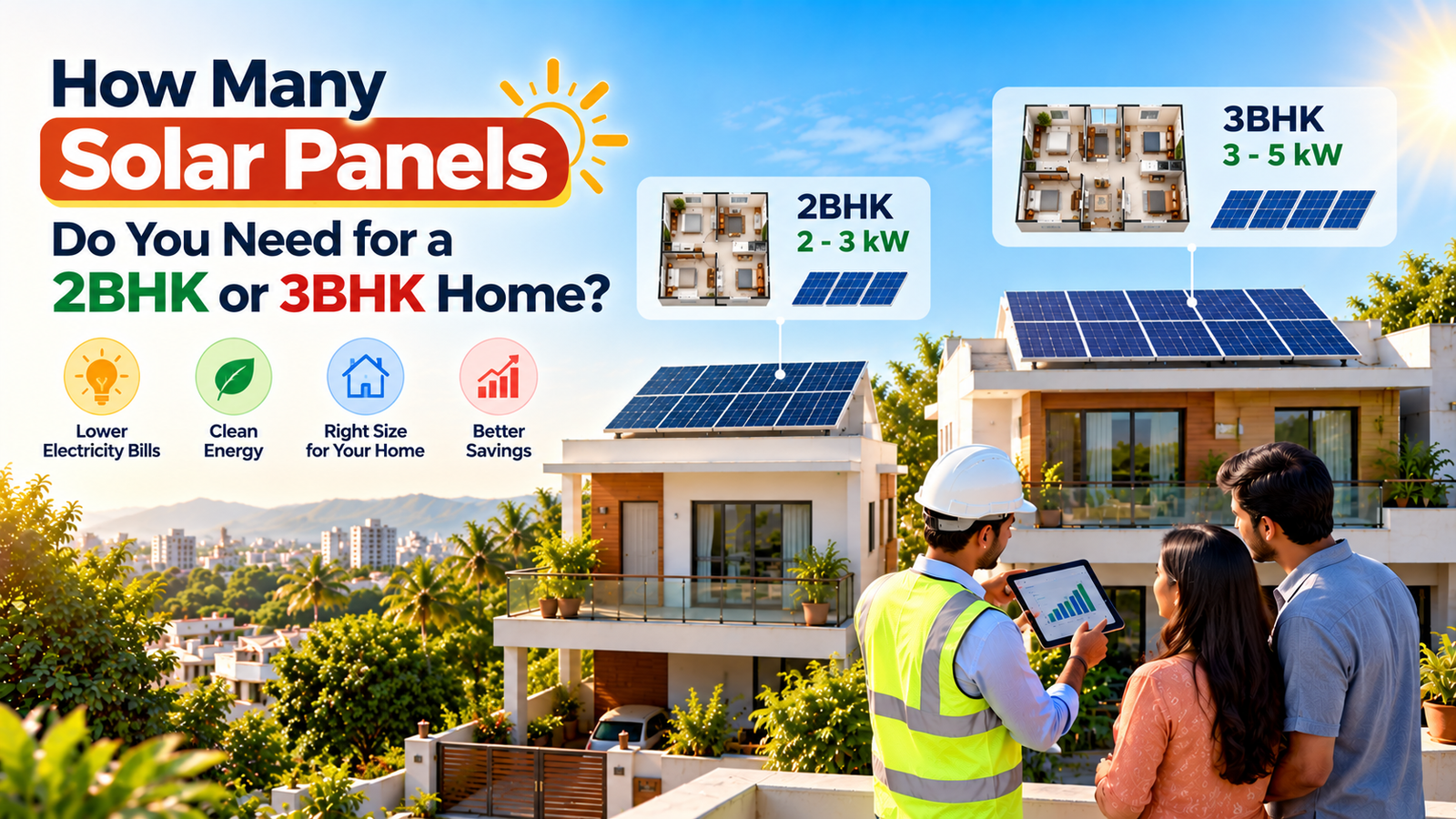
How Many Solar Panels Do You Need for a 2BHK or 3BHK Home?
Installing solar panels at home can help reduce electricity bills and make better use of renewable energy. However, one common question homeowners ask is: How many solar panels do you need for a 2BHK or 3BHK home?
The answer depends on your monthly electricity consumption, the appliances you use, available rooftop space, sunlight conditions, and the capacity of the solar system you plan to install.
A 2BHK home may need a smaller solar system than a 3BHK property, but the number of bedrooms alone does not determine the right system size. Understanding your electricity requirements is the first step toward choosing a suitable rooftop solar installation.
How Many Solar Panels Are Needed for a 2BHK House?
A typical 2BHK household consumes electricity through everyday appliances such as lights, ceiling fans, televisions, refrigerators, washing machines, and other electrical devices. . Homes with air conditioners, electric water heaters, or other high-consumption appliances may require a larger solar system.
For an initial estimate, a 2kW to 3kW solar system may suit some 2BHK households. The actual requirement should be calculated using electricity bills and expected daytime consumption.
For example, if you choose solar panels rated at 550 watts each, the approximate panel count would be:
| Solar system capacity | Approximate number of 550W panels |
| 2kW | 4 panels |
| 3kW | 6 panels |
These figures are estimates. The final number depends on the panel wattage and the system design selected by your installer.
How Many Solar Panels Are Needed for a 3BHK House?
A 3BHK home may have higher electricity consumption because of its larger living area, additional appliances, or greater cooling requirements. However, a well-managed 3BHK home may use less electricity than a 2BHK home with multiple air conditioners.
For an initial estimate, a 3kW to 5kW solar system may be appropriate for some 3BHK households. Homes with heavier electricity consumption may need a different system capacity.
Using 550W panels as an example:
| Solar system capacity | Approximate number of 550W panels |
| 3kW | 6 panels |
| 4kW | 8 panels |
| 5kW | 10 panels |
The suitable capacity should be based on your actual electricity consumption rather than the size of your home alone.
Quick Comparison: Solar Panels for 2BHK vs. 3BHK Homes
| Home type | Illustrative system range | Approximate 550W panel count |
| 2BHK | 2kW–3kW | 4–6 panels |
| 3BHK | 3kW–5kW | 6–10 panels |
These ranges are starting points, not fixed recommendations. Your requirements may be lower or higher depending on electricity usage, appliance choices, location, and roof conditions.
What Determines the Number of Solar Panels You Need?
1. Monthly Electricity Consumption
Your electricity bill is one of the most useful ways to estimate your solar requirements. Review the units consumed over several months, especially if your usage changes significantly during summer.
A household that consumes more electricity will generally require a larger solar system to offset a greater portion of its usage.
2. Appliances Used at Home
Different appliances have different power requirements. Common examples include:
- Fans and LED lights
- Refrigerators and televisions
- Washing machines
- Air conditioners
- Electric water heaters
- Water pumps and other electrical equipment
Homes that regularly use multiple air conditioners or other energy-intensive appliances may need more solar capacity.
3. Solar Panel Wattage
Solar panels are available in different power ratings. Higher-wattage panels can provide more rated capacity per panel, potentially reducing the number required for a particular system size.
For example, a 3kW system needs approximately six 550W panels, while a design using lower-wattage panels would require more modules to reach a similar capacity.
4. Sunlight and Location
Solar electricity generation varies with location, sunlight availability, roof orientation, shading, weather, and installation angle. A system in a well-exposed location may generate more electricity than a similar system affected by shadows.
Your installer should assess local conditions before estimating expected generation.
5. Available Rooftop Space
The roof must have enough suitable space for the proposed panels and mounting structures. Water tanks, parapet walls, nearby buildings, and other obstructions can limit the usable area.
The layout should also leave appropriate access for cleaning, inspection, and maintenance.
6. On-Grid, Off-Grid, or Hybrid System
The system type also affects how solar electricity is used and stored.
- On-grid solar: Connected to the electricity grid and may use net metering where permitted.
- Off-grid solar: Designed to operate independently of the utility grid and typically requires battery storage.
- Hybrid solar: Combines grid connection with battery storage, depending on the system design.
When selecting a solar system, consider your battery storage needs, backup power requirements, and applicable local regulations.
How to Estimate Your Solar System Size
Follow these steps to get a more practical estimate for your home:
- Check the units consumed on recent electricity bills.
- Identify major appliances and note when they are used.
- Decide how much of your electricity consumption you want solar to cover.
- Ask an installer to estimate the system capacity based on local solar conditions.
- Confirm that the rooftop can accommodate the proposed panel layout.
- Compare the expected generation, system cost, warranties, and applicable subsidy eligibility.
A professional assessment can help determine the appropriate system capacity and avoid installing a system that is unnecessarily large or too small for your needs.
How Much Rooftop Space Is Needed?
The space required depends on panel dimensions, panel wattage, mounting arrangements, roof shape, and access requirements.
As a broad preliminary estimate, a rooftop solar system may need around 60–100 square feet per kilowatt. Actual requirements can vary, so this estimate should not replace a site inspection.
For example:
- A 2kW system may require roughly 120–200 square feet.
- A 3kW system may require roughly 180–300 square feet.
- A 5kW system may require roughly 300–500 square feet.
These estimates include a general allowance for layout space. The installer should confirm the usable roof area and safe spacing for the proposed installation.
Can Solar Panels Cover the Entire Electricity Bill?
A properly sized solar system can offset a significant portion of a household’s electricity consumption, but complete bill elimination is not guaranteed.
Actual savings depend on solar generation, household usage patterns, grid electricity rates, fixed charges, net-metering rules, and the system’s performance. Homes that consume more electricity at night may benefit from understanding how their on-grid or battery-backed system will meet those needs.
Ask your installer for a realistic generation estimate and a clear explanation of how the system is expected to affect your bill.
Common Mistakes to Avoid When Choosing Solar Capacity
Avoid these common mistakes when planning a residential solar installation:
- Choosing system capacity based only on the number of bedrooms.
- Ignoring summer electricity consumption and air-conditioner usage.
- Estimating panel count without checking individual panel wattage.
- Overlooking shading and rooftop obstacles.
- Assuming the system will eliminate every component of the electricity bill.
- Selecting an installer without reviewing equipment specifications, warranties, and service support.
Planning around your real electricity requirements can help you make a more informed decision.
Frequently Asked Questions
1. How many solar panels does a 2BHK home need?
Some 2BHK households may suit a 2kW–3kW system, equivalent to approximately four to six 550W panels. The correct size depends on electricity consumption, appliances, sunlight, and available roof space.
2. How many solar panels does a 3BHK home need?
Some 3BHK households may require a 3kW–5kW system, equivalent to approximately six to ten 550W panels. Higher or lower capacity may be appropriate depending on household usage.
3. Is a 3kW solar system enough for a 3BHK home?
It may be sufficient for some households, but homes with several air conditioners or high electricity consumption may need a larger system. Check your electricity bills and obtain a generation estimate before deciding.
4. Can I install solar panels if my roof is small?
Yes, provided there is enough suitable space for the required system. Higher-wattage panels may help make efficient use of limited space, but the final design must consider shading, panel spacing, structural safety, and maintenance access.
5. Does the number of solar panels affect the subsidy?
Eligibility for government assistance depends on the applicable scheme rules, system capacity, installation requirements, and other conditions. Check the current official guidelines before budgeting for a subsidy.
6. Should I choose an on-grid or hybrid solar system?
An on-grid system may suit homes that primarily want to reduce grid electricity consumption. A hybrid system may be preferable when battery backup is also important. The best choice depends on your budget, backup needs, and local installation conditions.
The number of solar panels required for a 2BHK or 3BHK home depends mainly on electricity consumption, appliance usage, panel wattage, rooftop space, and local sunlight conditions.
As an initial guide, some 2BHK homes may suit a 2kW–3kW system, while some 3BHK homes may benefit from a 3kW–5kW system. These are estimates rather than universal rules, so a review of your electricity bills and a professional rooftop assessment are important before installation.
Planning to switch to solar? Get in touch with Lumen Solar to evaluate your home’s electricity needs, discover the right solar system, and plan an installation that suits your requirements.
Leave a comment