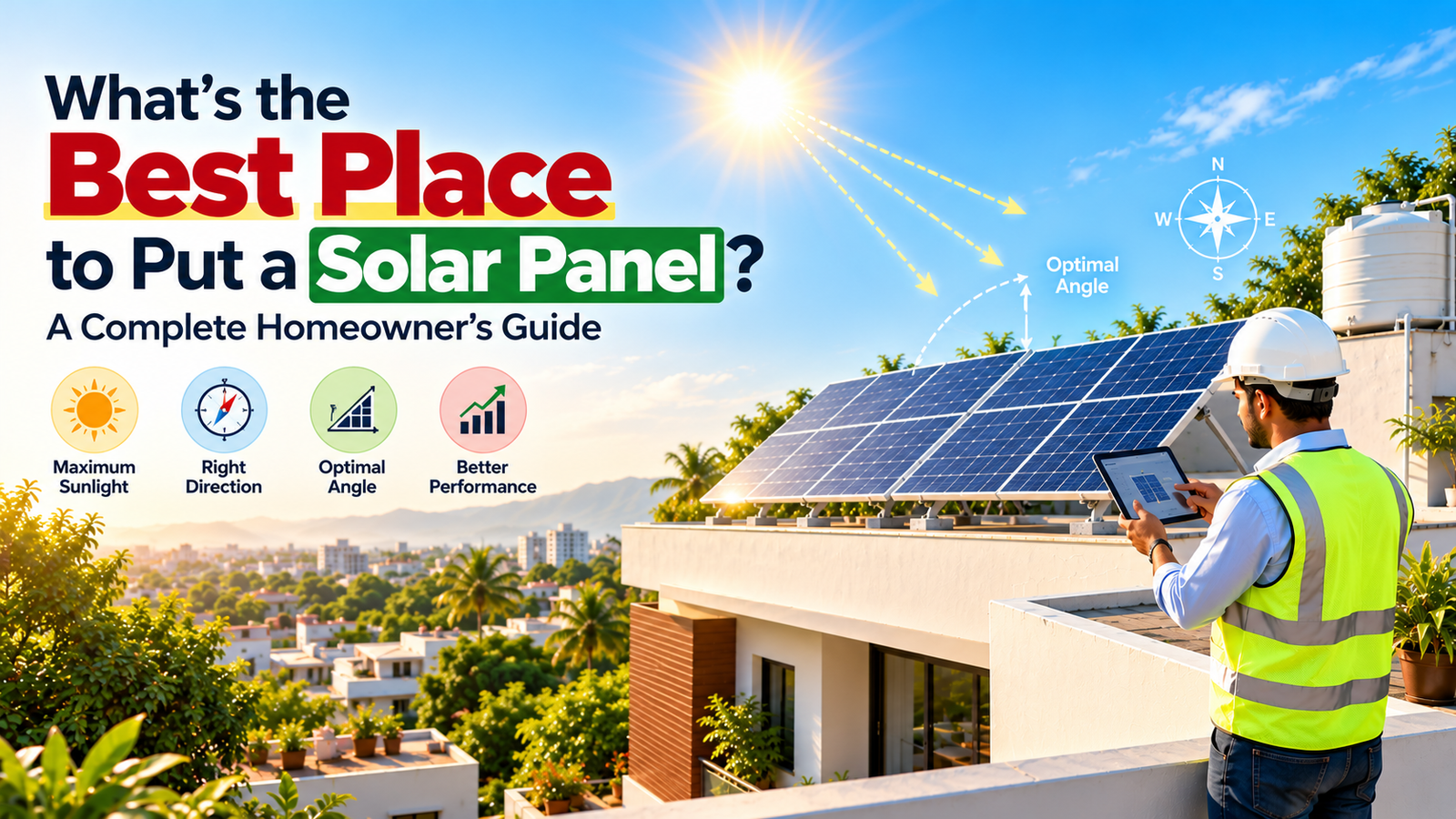
What’s the Best Place to Put a Solar Panel? A Complete Homeowner’s Guide
Choosing the best place to put a solar panel is essential for maximizing electricity generation and getting the most value from your solar investment. Even high-quality solar panels may produce less electricity if they are installed in shaded areas, positioned in an unsuitable direction, or placed at an inappropriate angle.
For homeowners planning a rooftop solar installation, factors such as sunlight exposure, roof orientation, solar panel angle, and available space play an important role in determining system performance. A properly planned installation can help make better use of available sunlight while allowing convenient access for cleaning and maintenance.
Whether you are installing solar panels on a residential rooftop or considering a ground-mounted system, understanding the available options can help you make an informed decision. This guide explains the ideal locations for solar panels, the best direction for solar panels in India, common placement mistakes, and practical tips for improving solar generation. best place to put a solar pane
Why Is Solar Panel Placement Important?
Solar panels use photovoltaic cells to convert sunlight into electricity. The amount of electricity generated depends partly on how much sunlight reaches the panels throughout the day.
Poor placement can reduce energy production and affect the overall value of a solar installation. For example, panels installed near a tall building or underneath a large tree may receive less sunlight than panels positioned in an open area.
Correct solar panel placement can help homeowners:
- Capture more available sunlight.
- Reduce the impact of shading.
- Improve the use of available rooftop space.
- Support better solar system performance.
- Maintain convenient access for cleaning and inspection.
- Make more informed decisions about system capacity.
The objective is not simply to install the maximum number of panels. Instead, the system should be positioned to achieve an effective balance between electricity generation, safety, space utilization, and maintenance.
What Is the Best Place to Put a Solar Panel?
For most Indian homes, an open rooftop with minimal shading is often the best place to put a solar panel. Rooftops generally provide access to sunlight while keeping the panels away from many ground-level obstructions.
However, the largest available roof area is not necessarily the most suitable location. The installer should identify the sections that receive sufficient sunlight while accounting for nearby buildings, water tanks, parapet walls, roof structures, and maintenance pathways.
The ideal location depends on several factors:
- Roof orientation and tilt.
- Daily sunlight exposure.
- Nearby sources of shade.
- Available usable space.
- Structural strength of the roof.
- Electrical installation requirements.
- Access for inspection and cleaning.
- Household electricity consumption.
A professional site survey can help determine the most suitable layout for your property.
1. An Open Rooftop With Minimal Shading
An open rooftop that receives unobstructed sunlight for much of the day is generally an excellent location for residential solar panels.
Before installation, inspect the roof for objects that could cast shadows over the panels, including:
- Trees and large branches.
- Nearby buildings.
- Water tanks.
- Parapet walls.
- Staircase enclosures.
- Chimneys and ventilation outlets.
- Antennas and satellite dishes.
These obstacles may create shadows during the morning, afternoon, or different seasons. Even when the roof receives strong sunlight at midday, shading at other times can influence total electricity generation. best place to put a solar pane
A professional installer can assess the available roof sections and recommend an appropriate panel arrangement. If shading cannot be avoided completely, suitable system design and equipment may help manage some of its effects.
2. The Best Direction for Solar Panels in India
The best direction for solar panels in India depends on the property’s location, roof design, electricity consumption pattern, and the desired generation profile.
For many fixed rooftop installations in India, south-facing panels are a useful starting point because this orientation can provide strong overall sunlight exposure throughout the day.
However, south-facing panels are not automatically the best option for every home.
East-facing panels may be useful for households that consume more electricity in the morning. West-facing panels can help align generation with afternoon electricity demand. The final choice should consider the roof’s available orientation and the household’s energy usage.
| Panel direction | Potential advantage | Important consideration |
| South-facing | Can provide strong overall daily sunlight exposure | Check shading, tilt, and roof conditions |
| East-facing | Can favour morning electricity generation | Afternoon generation may be lower |
| West-facing | Can favour later-day electricity generation | Morning generation may be lower |
| North-facing | May be less favourable for fixed systems in much of India | Requires careful site-specific assessment |
These are general guidelines rather than guaranteed performance rankings. Local conditions, roof angle, shading, and system configuration can change the results.
Before finalizing the installation, ask your solar installer to evaluate the available orientations instead of relying on a general rule alone. best place to put a solar pane
3. Choosing the Right Solar Panel Angle
The solar panel angle refers to the tilt at which panels are installed relative to the horizontal surface. This angle affects how sunlight reaches the photovoltaic cells.
On a sloping roof, panels may be installed parallel to the existing roof if the angle and orientation are suitable. On a flat rooftop, mounting structures can be used to establish an appropriate tilt.
The ideal solar panel angle depends on:
- The property’s geographical location.
- The direction in which the panels face.
- Roof design and available space.
- Structural and wind-loading considerations.
- The intended system layout.
- Local installation requirements.
There is no single tilt angle that is ideal for every rooftop in India. A suitable design should account for the property’s conditions and the installer’s technical assessment.
A poorly planned mounting arrangement may reduce energy production, create unnecessary wind exposure, or interfere with maintenance access. Professional design helps address these considerations before installation begins. best place to put a solar pane
4. A Flat Rooftop With Sufficient Usable Space
Flat rooftops are commonly used for residential and commercial solar installations in India.
One advantage of a flat roof is the flexibility it provides when arranging panels. Mounting structures can be designed to establish a suitable orientation and tilt, subject to site conditions.
However, the layout needs to prevent one row of panels from casting shadows on another. The installer should also account for:
- Water tanks and other rooftop equipment.
- Parapet walls.
- Drainage points.
- Staircase access.
- Maintenance pathways.
- Structural load limits.
- Wind exposure.
- Cable routing.
A flat rooftop does not need to be completely covered with panels to support an effective installation. The aim is to use the most suitable sections while preserving safe access and maintenance space. best place to put a solar pane
5. A Sloping Roof With a Suitable Orientation
Sloping roofs can also be suitable for solar panel installation, provided the roof’s structure, condition, and orientation are appropriate.
Panels can sometimes be mounted parallel to the roof surface, which may simplify the installation. In other cases, a different mounting arrangement may be required.
Before proceeding, a professional installer should evaluate:
- Roof material and condition.
- Structural strength.
- Mounting points.
- Waterproofing requirements.
- Panel orientation.
- Shading from nearby structures.
- Safe access for installation and maintenance.
If the roof requires repairs, it is generally sensible to address them before installing solar panels. Doing so can help reduce the possibility of removing and reinstalling equipment later. best place to put a solar pane
6. A Ground-Mounted Area
If the rooftop is too small, heavily shaded, or unsuitable for installation, a ground-mounted solar system may be an alternative when adequate land is available.
Ground-mounted panels can provide greater flexibility in selecting the orientation and tilt. They may also be easier to access for inspection and cleaning.
However, ground-mounted systems require suitable land, stable foundations, appropriate sunlight exposure, and protection against accidental damage.
The total project cost can be influenced by site preparation, mounting structures, electrical cabling, and other installation requirements.
For homeowners with sufficient open land, comparing rooftop and ground-mounted options can help identify the more practical solution. best place to put a solar pane
How Does Shading Affect Solar Panel Performance?
Shading is one of the most important factors to consider when deciding where to install solar panels.
When a tree, nearby building, water tank, or other object blocks sunlight, the affected panels may produce less electricity. The extent of the impact depends on the duration and location of the shade, panel arrangement, and electrical configuration. best place to put a solar pane
Before installation, observe how shadows move across the rooftop during different parts of the day. It is also important to consider seasonal changes because the sun’s position changes throughout the year.
Depending on the installation, technologies such as microinverters or DC optimizers may help manage certain shading-related losses. Their suitability and cost should be evaluated by a qualified professional.
Trimming vegetation may sometimes help, but only where it is appropriate and permitted. In other situations, changing the panel layout may be a better option.
How Much Roof Space Do Solar Panels Need?
The space required depends on the system capacity, panel dimensions, mounting arrangement, roof shape, and access requirements. best place to put a solar pane
As a preliminary planning estimate, approximately 60–100 square feet of usable roof area per kW may be needed for many residential installations. Actual requirements can differ according to the equipment and layout.
| Solar system capacity | Approximate planning area |
| 1 kW | 60–100 sq. ft. |
| 2 kW | 120–200 sq. ft. |
| 3 kW | 180–300 sq. ft. |
| 5 kW | 300–500 sq. ft. |
| 10 kW | 600–1,000 sq. ft. |
These figures are estimates rather than fixed requirements. Rooftops with water tanks, parapet walls, staircase structures, or shaded sections may offer less usable installation space than their total area indicates.
A site survey should be completed before the final system capacity and panel layout are confirmed.
Roof vs Ground: Which Location Is Better?
Both rooftop and ground-mounted solar installations can be effective, but the right choice depends on your property’s conditions.
Rooftop solar
Rooftop solar makes use of an existing building surface and is often suitable when the roof has adequate sunlight, sufficient usable area, and appropriate structural strength.
It can be a practical option for homes where land is limited.
Ground-mounted solar
Ground-mounted systems may be worth considering when sufficient land is available but the roof is unsuitable or too small. best place to put a solar pane
They provide more flexibility in arranging panels but may require additional site preparation and cabling.
Before deciding, compare the available space, shading, structural requirements, installation cost, and maintenance access. A professional evaluation can help determine the most suitable option for your specific requirements.
Common Solar Panel Placement Mistakes to Avoid
Even high-quality solar equipment can underperform when the installation layout is poorly planned.
1. Ignoring Nearby Trees and Buildings
Do not assess sunlight only at midday. Shadows shift across the rooftop throughout the day and vary with the changing seasons.
2. Selecting a Location Only for Convenience
The easiest section of the roof to access may not receive the best sunlight. Compare possible layouts before making a decision.
3. Covering the Entire Roof Without Planning Access
Solar panels should not obstruct essential drainage points, access routes, or rooftop equipment. Maintenance access should remain part of the design.
4. Overlooking Structural Strength
The roof and mounting structure must be suitable for the installation. Where structural concerns exist, obtain an appropriate professional assessment.
5. Ignoring Future Maintenance
Panels should be positioned so that inspection and cleaning can be carried out safely. Difficult access may complicate routine maintenance.
6. Using the Same Angle for Every Roof
The correct tilt depends on location, orientation, roof conditions, and system design. A generic angle should not replace a site-specific assessment.
7. Choosing a System Size Before Assessing the Roof
The solar capacity should match household electricity requirements and the available installation area. A site survey can help prevent an unsuitable layout.
How to Choose the Right Location for Your Home Solar System
Before installing rooftop solar panels, homeowners should evaluate their property carefully to identify the most suitable installation area.
Step 1: Inspect the Available Roof Space
Examine the rooftop and identify potential obstacles, including water tanks, parapet walls, ventilation outlets, and staircase structures. These features can limit the space available for panel installation.
Step 2: Evaluate Sunlight and Shading
Observe how sunlight reaches different parts of the roof during the day. Consider shadows from nearby buildings, trees, and rooftop structures, as well as seasonal changes that may affect solar electricity generation.
Step 3: Analyze Your Household’s Power Needs
Check your recent electricity bills to estimate your household’s energy consumption. Understanding your usage patterns can help determine an appropriate solar system capacity.
Step 4: Assess Different Panel Arrangements
Discuss alternative panel layouts and orientations with your solar installer. The final design should make effective use of available roof space while considering sunlight exposure and convenient access for future maintenance.
Step 5: Verify Roof Strength and Safety
Before installation, confirm that the roof and proposed mounting system are suitable for the planned solar array. Seek a qualified professional’s assessment to address structural requirements and installation safety.
Step 6: Allow Space for Future Servicing
Ensure the layout provides sufficient access to solar panels, electrical equipment, and rooftop drainage areas. Proper access can make routine inspections and maintenance easier.
Step 7: Examine the Installation Proposal
Before making a decision, review the system capacity, panel and inverter specifications, mounting design, estimated electricity generation, warranty coverage, and installation costs. best place to put a solar pane
Following these steps helps homeowners select a solar installation layout based on their property’s actual conditions and energy needs.
Frequently Asked Questions
1. Where should solar panels be installed on a house?
An open rooftop that receives consistent sunlight and has minimal shading is often a suitable choice. The final location depends on roof orientation, structural suitability, available space, and household electricity requirements.
2. Which direction is suitable for solar panels in India?
South-facing panels are commonly considered for fixed solar installations in India. However, east- or west-facing panels may also be suitable depending on the roof layout, local conditions, and household energy consumption patterns.
3. Are flat rooftops suitable for solar panel installation?
Yes, flat roofs can support solar installations when appropriate mounting structures are used. The design should account for panel tilt, spacing between rows, shading, wind exposure, drainage, and maintenance access.
4. Do trees affect solar panel efficiency?
Yes. Tree shadows can reduce the sunlight reaching solar panels and may lower electricity generation. Reviewing shading patterns before installation can help identify a more suitable panel arrangement.
5. Should I choose rooftop or ground-mounted solar?
The right choice depends on the property. Rooftop systems use existing roof space, whereas ground-mounted installations may provide greater layout flexibility when sufficient suitable land is available. Compare site conditions, installation costs, and energy requirements before deciding.
6. Why is the solar panel tilt angle important?
The tilt angle affects how directly sunlight reaches the panel surface. An appropriate angle should be selected according to the installation location, roof design, panel orientation, and system requirements. best place to put a solar pane
7. Can homeowners decide where to install solar panels?
Homeowners can identify potential locations and visible shading issues. However, a qualified solar installer should verify the final layout, structural requirements, electrical connections, and safety considerations.
8. What are the best ways to improve solar panel performance?
Choose a location with good sunlight exposure, minimize avoidable shading, install suitable equipment, and follow recommended inspection and maintenance practices.
Finding the best place to put a solar panel requires more than identifying an empty section of the roof. Sunlight availability, shading, roof orientation, panel tilt, structural strength, and maintenance access all influence the suitability of an installation location.
For many Indian households, an unobstructed rooftop provides a practical starting point. However, the ideal arrangement depends on the property’s design, local sunlight conditions, and electricity consumption. best place to put a solar pane
Careful planning and professional guidance can help homeowners use their available roof space effectively and improve their solar system’s electricity generation potential.

Leave a comment